This is part 3 of my ongoing series of drop back passing concepts out of the Wing-T. Part 1 was the Stick Route concept and Part 2 was the Slant/Angle Route concept.
When I talk with Wing-T coaches, most of them pass very rarely (15-20% of a game) and use the pass as a home run shot or warning shot to back off the secondary. I feel that there is more that can be done is this facet of the Wing-T offense and can be installed without sacrificing time on the run game.
Part 3 is focusing on the Spacing concept out of Wing-T sets. This is more of a horizontal stretch of the defense and we are looking to quick strike in an open zone. I feel this is a solid option for an offense that is facing a 3rd and 5-6 yards because the defense maybe loading the box for the run, but being very aware of the play action passing due to the intermediate yardage the offense has to gain. This puts a Wing-T offense in a bind because you have a defense who is being alert to the pass just as much as the run. Also, many of the play action passes attack one side of the field, so defenses can prep themselves for any possible play action passes to their side.
With this 3-step drop concept and my other quick game concepts, you can drop back and hit the defense in underneath zones due to the horizontal stretch created by the concepts. Also, the concepts are active on both sides of the field and so the best situation can be attacked if available. So if a defense is aggressive and attacks, there should be an opening somewhere due to a defender being out of position for the pass coverage. If the defense drops due to the QB dropping, now the horizontal stretch of each concept attacks the open zones.
Now, back to the Spacing concept itself. We are looking to run an all stops/hitches concept out of the Wing-T sets. The key with this concept being run from such compressed formation is that you have to train the players to be aware of spacing of the defenders and how to manipulate that space. I have different responsibilities for different receivers based on how many linebackers are in the box. Those route responsibilities are Space and Hunt.
With Space, your responsibility is to attack the OLB's inside or outside shoulder, depending on his align. If he aligned inside of the receiver, the receiver attacks the inside shoulder of the LB and sit down in your route. If he is aligned outside of the receiver, the receiver attacks the outside shoulder of the LB and sit down in your route. The goal of the Space responsibility is to stretch the LB horizontally so it can help give room for another receiver's route. If the LB doesn't adjust to the Space, then the Space receiver should be open.
With Hunt, your responsibility is to find the open zone in the defense and get open. The Space receiver is trying to give you room, so you need to adjust your route off the secondary and the LBs. If the OLB is inside of you, you will be looking to run your stop route either vertically from your alignment or slightly inside of that. If the OLB is outside of you, you will take a slight outside release to set up your route and work back inside.
Here are the route rules for the different positions:
Split End: Stop Route
Tight End: Stop Route; vs 3 LB = Space, vs 2 LB = Hunt
Wingback: Stop Route; vs 3 LB = Hunt, vs 2 LB = Space
Slotback (Wing on SE side, Slot formation): Stop Route; Same rules as TE
Halfback: Stop Route; Same rules as WB except for Bunch formation = Bubble
Here are few variations of the play out of different formations and different defensive alignments:
Hope this has help spur some thought on how the passing game can be adapted to different offensive styles and that this concept could be something you could implement into an already dangerous offense like the Wing-T.
The next part of this passing series is going to start leading us towards the 5-step/sprint out intermediate and deep route concepts. More to come!!!
I was participating in the #txhsfbchat on Twitter last night and a question was posed about what technology do you use to help install an offense or defense...Great question!!!
So, the first thing that came to mind was Hudl...great tool to show film and cutups, great scouting tool, and has playbook making capabilities.
But that is when I remembered what we used at the last program I worked at...Google Drive.
We started using Google Drive about 2 years ago when one of the coaches on staff starting sharing team documents through it. I had not messed with Google Drive before, but right away I felt very comfortable with the formats. The documents you can make with Google Drive are very similar to the formats of Microsoft Office programs. Google Docs is equivalent to Word, Google Sheets is equivalent to Excel, and Google Slides is equivalent to PowerPoint. So from the start, there is a familiarity there due to the formats Google Drive shares with Office formats.
We would type up rules sheets on Google Docs, player rosters/depth charts on Google Sheets, and draw up schemes on Google Slides.
The one difference that makes Google Drive amazing over Office...Collaboration!!!
The ability to simply type in an email address and share a file on Google Drive is awesome. You can create a document and not just share it, but allow the person you shared the document with to alter the document and work with you on the same document (at the same time!!!).
Here is a few intro videos Google created to explain Google Drive/Google Docs:
All you need is a computer, a free gmail account, and you have access to all these great programs that allow great collaboration.
So how does this apply to football?
In the off season before the 2013 season, the defensive coordinator and I wanted to change the defense to a 4-3 Cover 4 defense, similar to Michigan State. We wanted to look at every formation an offense could possibly get into vs our defense and see how our base rules fit against the formation.
We started out by drawing up all the formations on Google Slides, labeling every formation and aligning our base defense against it. The DC and I would be working on the same document, same time, inputting all the formations, labels, and defenses. This is where the cool part comes in...there is a chat feature within every Google Drive program!!! So while we are working, we can chat to one another, using the chat box that is featured in the programs.
Most of us have families...so we can get very busy and have many other responsibilities beyond football. This ability to collaborate online, without being in the same room, is a time saver and it allows you to be at home with your family, take care of any needs at home, and still work on football at the same time. When this was all going on, I had a newborn in the house and the DC had 3 kids of his own that he had to take care of. Google Drive allowed us to be home for our families if they needed us, but we could be online talking football and working on schemes at the same time.
The Google Drive programs also have some great features that help with collaboration in a big way. The feature is great because as all of you work on the document together, you can chat things out on the fly. The other feature that is great is the comment "Sticky note" feature, especially if you and the other coaches are on different schedules and cannot get on at the same time. When you hit the comment button, it allows you to leave a "sticky note" on a slide or page of a document. This creates a running chat that you can type your thoughts on the scheme and the other coaches will see it when they log into the document.I use to leave notes all the time to tell the DC to tweak this or that on a certain slide...very handy and allows collaboration without having to be on at the same time.
Here is another Google video on discussions:
Some of the coaches on the chat asked if we did this with players...No, we didn't, but I could see some great positives with using Google Drive with players. You can have a chalk talk from home and have a time where both you and the players can draw stuff up and discuss how to attack/defend the scheme. Rules can shared and then discussion among coaches and players.
The key is you need to get Google Drive running and just experiment with it!!!
You can find all kinds of videos like what I shared on this article to help explain to you how Google Drive works. Also, feel free to contact me and I can walk you through some things.
I wrote about RPOs in a previous article (here) and how I feel that the next wave of change in football is going to be the use of RPOs, especially in the ever growing population of spread offenses.
So why the rise of RPOs? It's simple, really.
Defenses have started to develop ways to take away the base run plays of these spread offenses. As an individual that has run a spread offense, you find very quickly that there are limitations in the run game out of a spread formation versus a Wing-T or Power I formation. You have 5 linemen, a running back, and a quarterback. You find that you have to be very creative with blocking schemes or start optioning someone. You are left with limited amount of plays to run and limited amount of ways to block them.
Defenses started to pick this up and have devised ways to take away your options. It can be through defensive alignments (double eagle looks) or defensive techniques (gap exchange). Their goal is to even further limit or eliminate your run game. This leads to more passing, which can lead to you being one-dimensional...which is never good usually. So offenses need to find a new wrinkle in the run game to help overcome this adaptations by the defense, which has led to development of RPOs.
So why RPOs?
You are taking 2 plays and combining them into a single play and reading the defense on which part of the hybrid play you are running. A read system that is more advanced than previous offensive plays or is being used in a new way (triple option football but with pass, instead of the pitch!). There are all kinds of ways you can mix in the run with pass, but how to know what kind of RPO is good for you?
It really depends on what your personnel is and what your philosophy is on offense. If you have an athletic QB and you are looking to run him a lot, then it gives you a triple option effect when using a RPO play. If your QB is not as mobile, but can pass well, that gives you a pass option with a run play (in a sense a double option, just with either a RB run or QB pass). People are designing RPOs based on personnel, formation choice, and how people defend them. They want an added dimension in the running game that can attack more than just the standard read keys of option football.
Triple Option RPOs
The goal of a triple option RPO is to run the standard zone read concept by have an added pass route as the third option if the QB is attacked by the force player. This is usually accomplished by tagging a bubble or hitch (smoke) screen route to zone read play. The single receiver side fade/curl has been made popular by Auburn as its' third option in a RPO. Also, a new wrinkle to this concept has come up lately is the use of an arrow route as the third option of the play. Any route can be used, it just that you are looking to read the force defender and throw the route if the force defender attacks the QB. It is a zone read run play until the QB has to pull, which almost makes it into a sprint out pass with a run/pass option based on force player. Any zone play can be run with these (IZ/MZ/OZ) or people even use gap scheme plays like power/sweep. The key is to read the E for the run read, then read the force defender for the run/pass option out wide.
Here a few examples of Triple Option RPOs:
And there is probably many more routes/options out there, but here are your basic Triple Option RPOs. You are reading the E first for the run option, then looking at the force defender (either SS or C) to determine your choice on the run/pass option once the QB gets on the edge.
Double Option RPOs
The reason the next RPOs are just double options is because you are taking the QB running option out of the equation. We are now just reading a single defender or situation, which then lead to either a run or a pass. The other difference is now the pass routes involved with the play are going downfield more. The triple option RPOs were just screen passes or passes that stay tight to the LOS. With the double option RPOs, you are looking at your quick game routes being used, like Slants, Sticks, and Fades. So instead of a zone run with a sprint out run/pass option (triple option RPOs), we have a zone run with a quick drop back pass tied in (RPOs).
This is where the Double Option RPOs get tricky because coaches use these plays in different ways.
Some coaches will teach a QB to pull and throw is a pre-snap/post-snap situation develops. It is not necessary a read of a single defender, but more the structure of the defense. If the defense gives you the run option, take the run option; if the defense gives you the pass option, take the pass option. This might be an IZ Slice play (H back or FB kicks out BS DE) tagged with a bubble. If the defense is not respecting the run, then hand it off for the run. If the defense is hugging too tight to the OL and not in position to cover the bubble, throw the bubble. That is a RPO play that really is reading a defense, not a single defender...get yourself in the best play.
The other way Double Option RPOs are run is by having the QB read a single defender and either hand off/throw based on the action of the defender. The player that probably gets read the most is BS LB in the box. The zone plays will now be blocked differently, with the BST blocking back on the DE and everyone else running standard zone blocking. This leaves the BSLB unblocked and the read key. The QB will hand off if the BSLB is just standing still or slightly dropping while the mesh is occurring. If the BSLB attacks the run, the QB will pull and throw to the pass route tagged in the RPO. As far as what run plays to use, you have to be careful here. If you use IZ, the OL will be getting up field, so you have to have the ball out quick on the pass option or you will be penalized for having OL beyond 3 yards. My personal choice would be to use an OZ or sweep play because the OL will be reaching more than driving up field. Some people also use a draw play, which again is a play where the OL will not get up field.
Here are a few examples of Double Option RPOs:
Again, there are probably many other ways of running a double option RPO, but these are the few that I have seen run. The goal with the double option is to isolate a single defender, read him, and make him wrong every time with either the run or the pass.
So does the defense have an answer for RPOs?
The answer right now seems to be running Cover 1 or 0 vs a heavy RPO team. The man coverage takes away a lot of the options available and possibly gets another guy in the box. That can be a good or bad thing for a defense. If you run zone exclusively most the year, are you comfortable changing it up and going man? Are your DBs good enough to lock up man with the offense's WRs? That is where the "chess match" comes into play in the game of football.
Here is a great video (done by Coach MacPherson of playfastfootball.blogspot.com) that does a great job of explaining the "chess match" between the RPOs and the defenses:
This is the next evolution of football...I used the term "evolution" on purpose. Offenses and Defenses are constantly adapting and changing techniques/philosophies to out compete the other...to gain an advantage. Sometimes those periods of evolution involve an old idea being infused with new concepts. Triple option ball has been around for awhile, but just now are we seeing a pass integration into the triple option philosophy.
This is why I love football so much. I love working the players and developing them into great people and leaders...but it is also the "chess match" that I love about the game. It is a demonstration of who can take the talent on their team, develop a scheme that is effective and can be implemented by your talent, and execute that scheme against someone who developed their own scheme to stop yours or score on yours. Football is a much deeper game then what people give it credit for...it shapes people's lives and brings out some of the most creative parts of our minds and puts it on display.
I just took in my first 7 on 7 passing scrimmage this last week. I was there to check out one of our conference opponents. Out of the 3 teams that participated in the scrimmage, 2 of them ran a 5-wide, pass-heavy offense.
While watching these teams run their offenses vs varying defenses, many ideas came to mind:
1) It's the little things that matter...minor details lead to big gains.
When it comes to any offense, there are subtle adjustments/alignments that teams use to gain an advantage. As a former OL, the one that comes to mind right away is an OL's split. Depending on what play you are running, you may want an OL to either widen or shorten his split to help move the DL around and get them in a better position to block. Widen a split to set up trap, shorten down splits for outside runs, or widen your split to open up the B gap more for Iso or Belly. All are minor details that can lead to big gains for the offense.
Well, with that said, when watching these teams run their spread offenses, it was awesome to see the minor details taken to set up the defense. As a former assistant coach that helped call the defense from the press box, you kind of get trained to look for subtle details that the offense does to give you a clue of what play is coming. So when I watched the 7 on 7 scrimmage, I was looking for those subtle things that may tip me off to what plays or routes may happen.
You will notice with these types of spread offenses that the alignment / "splits" of the wide receivers is a key to figuring out what routes are going to be run. The thing is that there is just as much variety of splits used by a WR versus splits used by an OL.
First, I always look at the outside WR, no matter how many WRs are on that side.
If the outside WR is tight, then you are looking at some kind of out cut.
If the outside WR is wide, then you are either seeing an in cut or he is creating space for someone else to get the ball.
Next, if you have multiple receivers to a side, I look at the splits between the receivers.
If the receivers are wide apart, usually one is setting up the other one to get open with spacing or one of the receivers is going somewhere else (not working a combo route with him). So maybe they are wide because a stick route concept is on and they are isolating the inside receiver? Or are they going to run a drag with the inside receiver and the outside receiver(s) has a different route combo or responsibility in the play?
If the receivers are close together, usually there is going to be some kind of switch route or they are working a combo together. So a great example of this would be a trips look with an outside WR with a really wide split, with the inside WRs only a few feet from each other. Then you could get a Switch concept between the 2 inside WRs, and also work a Smash concept between the outside WR and the switching inside WR.
I saw a lot of tight splits between WRs due to one of the teams running press man coverage most of the time. That led to a lot of of switch routes and outside cutting routes due to the compression of the receiver's split.
Finally, another thing to look at is the structure of the formation, not just splits. A great example of this was done by a team with an extremely talented WR, who will be attending Pitt after this next year. Here is how they isolated him on an In route with their formation/routes:
First, look at the formation. The one side has stacked WRs, which were split wide. The other side is a typically twins look, with the inside WR slightly tighter to the OL. The back is set to the regular twins side of formation, which causes the defense to align a defender to that side to cover the RB man if he releases. When looking at the formation and routes, the goal is to drag the defense wide and isolate the stud WR in the middle of the field. All of this is done just by alignment of the WRs and simple route calls.
2) It's amazing how similar the 5-wide attack is to the Wing-T and other run heavy offenses.
No, I am not concussed nor have I lost my mind...
Let me start this out with a simple question...what offenses call for your defense to get out of its' base front/coverage due to the dramatic ability to move the ball?
I guarantee there would be 3 answers commonly given: Wing-T, Empty Passing, and Heavy Option teams.
SO ALREADY THERE IS A SIMILARITY!!!! HA!!!
All kidding aside, there is an underlying philosophy that these styles of offense live on...We have an answer for every alignment or adjust you have. No matter what you do, we will take advantage of it and attack you!
This is the key to understanding how to defend teams like this...you need to except their philosophy of constantly adapting and know what plays/formations they are going to use against you. As a defense, you need to take that information and prepare your team to defend those specific plays the offense will try to implement against your team.
For example, if you are playing a 5-wide attack and you plan to run man against them, you need to be preparing for routes concepts like switches, smash, outs, and digs. If you are playing a run heavy team, usually they look at what a DL is doing or if a secondary defender is getting to tight to the LOS. They will then run a play to take advantage of that technique, like a trap or a play action pass.
If you focus and filter what the offense can do to you defensive scheme, you can practice that filtered list of plays more during the week leading up to the game. That leads to a familiarity with the offense and what to expect. This can also lead to a defensive scheme that limits what a defender has to worry about in terms of reads or techniques. Ultimately, the more comfortable your defense is playing against the offense, the more likely you will win.
So even though these types of offenses can look dramatically different from one another, they are all running the same principles of reading the defense and trying to take advantage of your defense with specific plays.
3) When it comes down to it... TALENT wins!!!
Pretty straight forward...you got a bunch of studs that know how to play...you are going to win!
One of the teams at the scrimmage had some imposing receivers with great talent. They were 6'4 or 6'5 , while some of the defenders were more like 5'8. The coach of these WRs was not afraid to put that talent on show by calling out the WR, yelling out that he needs to bring this down (in front of the defense), and the play would be a fade to the called receiver. And based on what I observed, they were a percent 100% on making the catch. So the defense knew it was coming his way and the WR still made the play.
Talent doesn't necessarily guarantee a win, but if that talent is focused, coached up, and put into the right position to win.....you are going to win and win big!!!
Okay, time for another installment of drop back passing from the Wing-T and we are going to be focusing on Slant route concepts, including the Angle route as a modification of the slant.
The Slant route is another great quick passing game route that can be high percentage and gain huge yards. Usually you will see it paired up with an arrow route, a bubble, or even a streak, but can also be a great isolation route to the backside of a play. The route is usually a 3-step route for the receiver, planting on the outside foot, then turning at 45 degree angle to the inside and looking to get open. The depth and angle of the route can be changed depending on the level of complexity of the offense.
So...how can the Slant be used in the Wing-T offense? Most would say the SE can run it and maybe you pair another route up with him to get a combo route. Yes, that is one way to do it and I will show you ways of doing that later. The more interesting and unconventional way of running the slant concept in the Wing-T is run it on the TE/Wing or TE/HB side of the formation. I will let that soak in a little bit and introduce to you a "cousin" of the slant route...the Angle route.
In the diagram above, I want you to focus on the top box and ignore the streak routes for now. The one back is running what is called an Angle route. It sometimes is just a check route if the back has no blocking responsibility or it can be run at the snap of the ball. Many west coast/pro style offenses use the angle route as a way to get an athletic RB in space on a LB or the LBs are dropping so much that they are leaving the underneath wide open. A great example of a team that has used the Angle roue for years is USC. They used to run it with Reggie Bush all the time and have used the route with many of the athletes they have had on their team. The most recent player that USC ran the Angle route with was Nelson Agholor, who got drafted by the Eagles recently.
The video below shows Agholor running the Angle route from the backfield, starting at the 0:25 mark. Also, check out the play that starts at the 1:30 mark and you might see where I am going with the Slant/Angle tie-in:
The first play (0:25) I pointed out is straight forward...Agholor is in the backfield, runs an Angle route, out maneuvers a LB, and makes the catch. The second play (1:30) is the focus of how to get a slant concept run with a TE/Wing flank. The wing needs to run the initial steps of an arrow route (3-5 steps) and then bang it up field or inside, based on the coverage (just like how Agholor ran his route in the second play). The goal is to suck the LB outside and then beat him back inside. It would look very similar to this play drawn up by Smart Football about the BYU passing attack:
Now, the difference here is there is 2 other WRs to that side to help spread out the D. So how can you get the Wing isolated on a LB? You will have to take the TE and run him on a streak. This accomplishes two things: 1) Gives another route option that the QB can throw to and 2) The TE will pull the LBs deeper and wider to give the Wing more room to run his route.
Here are 2 examples of how the concept would work versus different defenses:
So to run a slant concept to the TE/Wing side or a TE/HB side, all you have to do is run the Slant route like an Angle route. That will give you the room you need to get open, even though you are in a compressed formation. If you want a TE/HB flank, then the TE will still run the streak and the HB will run just a normal Angle route from the backfield. Gives you the same read and concept!
Side note, look at the SE side and you really have a couple of route options to combo the SE's slant route with to attack the D. You can have the HB run a streak as well and that gives you an under concept. You can have him run a bubble/arrow route and that gives you that common horizontal stretch pass concept out of the quick game.
The QB will take a 3 step drop and will be looking for the slant/angle route on the TE/Wing side by keying the ILB/OLB to that side. If the QB is looking to hit the slant to the SE side, he needs to key the OLB (or flat defender) to the SE side.This is a high percentage throw that is looking to take advantage of a mismatch between a RB/WR and a LB.
Here are a few other examples of how the slant concept can be run out of different formations:
Again, another wonderful integration of a great, high percentage, quick game pass concept into the Wing-T offense! Hope this has given you some inspiration on developing a passing game out of the Wing-T, as I feel there is much untapped potential for passing out of the Wing-T.
Please feel free to leave me any feedback, good or bad, about this material, either by leaving a comment or tweeting me a message.
(Sorry, offensive guys, but I have been just as much a defensive guy as I have been an offensive guy over my 10 years...but if I had to choose, I would go offense ;) ).
The last couple of years I have helped call and develop a 4-man front defense, either based out of Quarters coverage or Cover 3 (changed based on personnel). I also was in charge of coaching up the defensive ends, which had a wide range of responsibilities to take care within the defensive scheme. We also played in a league that had a wide variety of offensive styles, with spread being the most prevalent (even though they varied among each other as well).
When I take over a position, offensively or defensively, I always look at what the top responsibilities of the positions and the skills needed for that position. For our DEs, you had to pass rush, smash down a tackle or TE, take on pulling guards, and play the option a certain way depending on what side of the formation you were on. I then develop drills based on those skills that need to be developed.
I do not like to do a million drills and try to get through them at warp speed. I like to create an all-encompassing drill that works multiple skills at a time and gives real-game feel/look. So to follow that blue print, the first drill I came up with was what I called R&R...READ & REACT. It is a simple drill where I have an end play as an OT and he will randomly pick one of five different blocks to execute. The goal is for the DE lined up opposite of the OT is the READ the block and REACT properly to that type of block. You first have to walk them through what the blocks are and the proper reactions to those blocks, but the kids picked up fast.Also, I would have the OT go on his movement and the DE had to get off the movement of the OT and R&R.
Here is what the different blocks looked like and the reactions for each block:
The blocks are the following(from left to right on diagram): Pass Pro, Counter pull, Reach, Base/Turnout, and Down block. Obviously, with a pass pro step, the DE just went into pass rush mode. With the counter pull, the end would chase the OT down the line, unless we had game planned him to sit on it because of option. For the reach block, he is looking to fight across and always stay outside of the OT. The base/turnout block requires the DE to smash the OT back and pinch down the B gap for plays like Iso/Belly. Finally, the down block required our DE to smash down the OT and try to prevent the OT from getting to LBs. He also had to be ready to wrong arm a pulling guard (I will talk more about this later).
Once we had go through multiple reps and worked both sides of the OT, we then had the DEs run the R&R drill versus a TE. In our defense, we played a DE heads up on a TE with his responsibility being the C gap inside. We had four blocks we would work here: Down block, Arc Block/Pass Release, Reach, and Seal Block. With the down block, we are doing what we did with an OT: smash down inside and prevent TE from getting to LBs. The arc release is a tough one for them to R&R, which required them to ride the TE a little to make sure it is not a reach block, then close it back down for a pulling guard or to get a pass rush. The reach block is a little different versus a TE because we are responsible for the C gap inside. So we taught them to take on the reach block with your outside arm, keep inside arm free while staying square, and don't wrap around backside of block until the ball has gone outside of your gap. Finally, if the TE tried to seal us from the inside, we would smash them down like we did with the OT's base/turnout block.
Here is what the TE R&R looked like:
So when you look at the R&R drill in its' entirety, it covers about 90% of the skills needed by the DEs. This was vital because if I only had 15 minutes of indy, I could do this for 10 minutes and get a lot of reps in, covering 90% of the skills needed. The other 5 minutes I could cover any weekly adjustments or taking on a pulling guard.
Speaking of taking on pulling guards, I have a great thing for you try to invest in. We had purchased the one year a huge, orange impact ball. It was the big ball that we would roll at players and they could work on wrong arming a pulling guard. We would either set up a simple drill, where an OT would down block, we would smash them down and wrong arm the ball. Great tool and allows for full contact on taking on a pulling lineman.
We took that drill to the extreme against one team that we faced last year. The team was a spread team that had to main run plays that gave people fits because they both involve a guard pulling, but resulted in two, widely different, attacks. They would run a trap play where the guard would pull and kick out the end, with the back hitting it up inside. The other play was what I called the power option, which involves the line blocking like power (OG pulling up through for LB) and the TB and QB sliding to the same side of the play. The QB would read the DE play side and either hand off to the TB on the DE closing down or keep the ball if DE widened to take the TB.
So with that in mind, I came up with the following drill. We had an OT, a OG (who would roll the impact ball at the DE at the snap of the ball), a TB, and me playing the QB. The DE would get into a 5 tech and at the snap at the ball would R&R first the OT, then look at the backfield to get clues on what to do. If he saw the QB turn his shoulders away from him, he would close down and wrong arm the impact ball. If he saw the QB shuffling with the TB, he would attack the mesh point square on and muddy the read.
Here is the setup for both reads:
It worked beautifully!
In the game, we ready handle the two different plays and made them abandon using the one because we nearly nailed both the QB and TB on the power option read. Our DEs had a good game, with even one of our backups having to play most of the game.
When you are making a drill for a position (Offensively or Defensively), you have to keep a few things in mind:
Is this a needed skill that will be used in a game?
Am I addressing multiple skills at a time, so I can save time?
Will I be able to get maximum reps, or will a bunch of guys being standing around?
Am I giving them a realistic, game-like experience with this drill?
Is it easy enough to teach to them in the off season and they can run it on their own when you cannot coach them directly in larger groups?
Hope this helps and thank you to all of you that have been checking out my posts! I am over 300 page views in only about a week and a half...a great start and I plan to continue to provide great information and theoretical ideas that you could possibly try with your program. Please feel free to leave me feedback, good or bad, about the blog or the information being presented on the blog.
The more I study the Wing-T and go "mad scientist" on its' schemes, the more I realize there is a lot more potential in the passing game from the traditional Wing-T formations then most people may realize. Wing-T is clearly known as a run-based offense that uses play action pass. I think there is a place for drop back passing in the Wing-T, which would only enhance the impact this offense can have on a defense. This would also answer the biggest problem with the Wing-T...what do you do if you get behind on the scoreboard or the defense is taking away the run game?
For the next couple of posts on this blog, I plan on showing you some common passing concepts that can be integrated into a traditional Wing-T offense. I will be covering all types of concepts, including quick game, intermediate/deep, and screens.
First up...the Stick route.
The Stick route is probably one of the easiest passing concepts there is in football, which also makes it one of the most high percentage passes used today. If you tune in to any college or pro football game, you will probably see this concept at least a handful of times. The receiver you typically see run this is the tight end, but if you are a spread team, it's going to be usually an inside receiver out of trips. A great example of this is the Patriots, with Gronk being the man running the stick route. Gronk is perfect to run this because he is big enough to post up/bang with a LB, but also has the speed/athleticism to run away from a defender.
The Stick route is an option route where the receiver will run a 4-6 yard route and determine to sit it down in a zone or to run an out to get away from man coverage. The receiver has to read the defense pre-snap and post-snap to either find that open zone or determine who is going to be running with him.
Here is a great video of John Carlson demonstrating the basics of the Stick route:
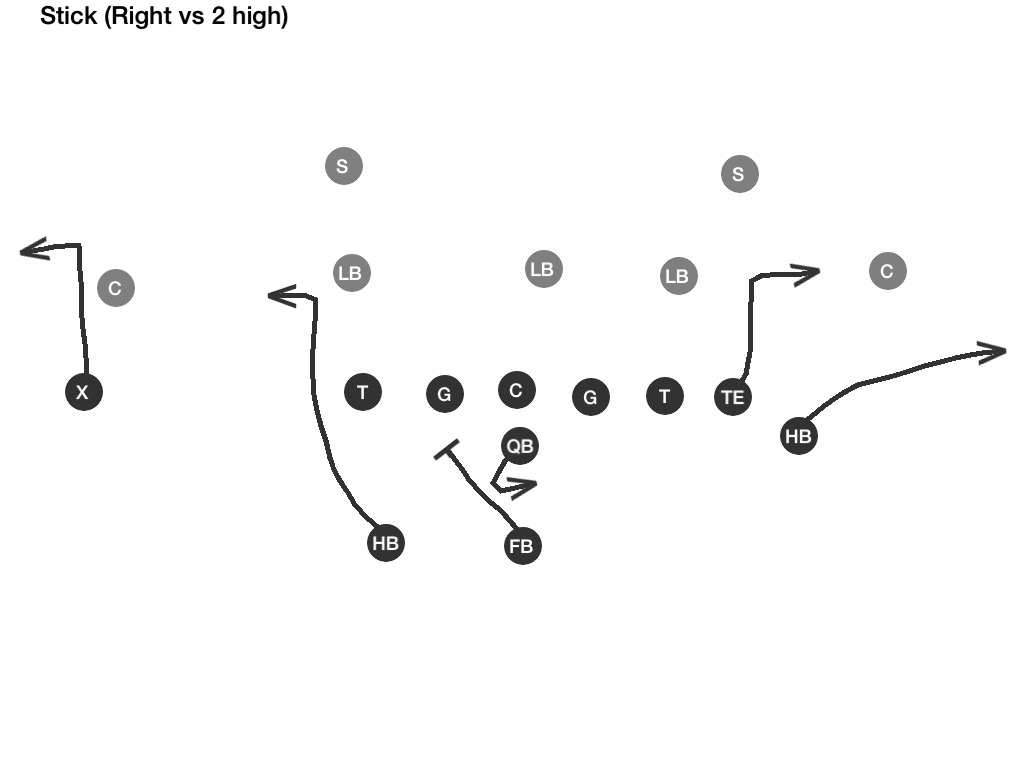
So an easy concept that can be run from many different formations/alignments? That sounds like a perfect type of pass for such a run-heavy offense like the Wing-T. I decided to sit down and draw up what the stick would look like out a traditional Wing-T formation.
Here is what I got:
First, I would like you to focus on the TE/WB side of the formation. This would be the main focus of the play, with the stick being run by the TE, and an arrow route being run by the WB. The arrow route is used to get the D spread out horizontally, so we create space for the stick route. The stick route can be converted into a hitch-like route or an out depending on 2 things: Secondary alignment and Linebacker Alignment. You will see that the TE is always looking for the void within the coverage. Also, with the alignment of the TE and WB being so compressed to the OL, it makes it harder for the secondary to match up with the receivers.
The QB will be looking to hit the stick route, but needs to peek at the arrow route to see if he is being left open. As far as the drop of the QB, I have two ideas on that: 1) Just do straight 3 step drop or 2) Open up to FB on short fake and pop open to throw. I like the 2nd option because I think you can suck in the LBs a little to open up the routes more, but I know the 1st option would work for sure (just no deception on the play being a pass).
Next, I want you to focus on the backside of the play, where the SE and HB are running their routes. I was pleasantly surprised how nicely this side of the play ended up. The HB is going to also run a stick route from the backfield alignment. Same rules as the TE, just from a different position. The best part of this side is the SE's route...the 8 yard out cut that is working to isolate him on the corner. This has been a great route from my previous teams and is a simple pass play that can get you good yardage. The idea is to run to a depth of about 8 yards, then break hard outside and come back to the ball (you should be at about a depth of 6 yards when you catch this). It is great against any man or cover 3 coverage.
So, in reality, there are 3 different areas of the field you can hit the D with this pass concept...the TE/WB stick-arrow combination, the HB on the stick route, or the SE on the bench route. All are easy, high-percentage throws that can gain you solid yardage. You just need to coach up the QB on what reads you want him to make or what rules dictate when he throws to the TE vs the HB vs the SE.
Now, this is not the only way to run the stick route concept. I have come up with some other ways you can get into the concept without compromising the integrity of the traditional Wing-T offense. All the formations I used are Wing-T formations with the HB moving to the strong/weak side in some formation. This allows the formation to form a trips look, which adds another level of complexity for the defense to adjust to.
Take a look:
Again, a very easy pass concept that can be adapted to almost any formation. The route is high percentage and I was able to pair it up with another concept (Bench route) to make more options available to the QB, which is also a high percentage throw. Finally, it is an option route that is easy to teach and requires minimal effort from the receiver to read and adjust.
Hope you enjoyed reading this and make sure to leave some comments on what you think or what kind of pass concepts you would like to see merged with the Wing-T.
The next concept I am looking to put together is the slant-arrow/ slant-seam combinations being integrated into the Wing-T.